How to run a meeting
Inquiry beats presentation
After running WindBorne for 4 years now, I have only just figured out how to actually run meetings.
I have never seen this management advice anywhere, which I’m surprised by, because once I made this discovery it completely changed how I work, and it feels somewhat obvious in hindsight. But I’ve never heard the concept before.
Let me start with the problem. Meetings with more than about three people seem to get really boring and really time-wasteful. So of course, I’m a fan of trying to delete meetings; most companies have too many unnecessary ones.
But you also can’t just delete every single group meeting. There is actually value in getting a decent-sized group of people in a room together to exchange information and communicate. But for my whole career, I’ve been unable to figure out how to do it without it always feeling… boring.
Compared to a 1:1 phone call, the rate of information exchange always seems to drop and get quite low, with not much utility happening, and many people getting bored. Take an engineering design review, for instance. These often need to be reasonably sized meetings, but it’s very boring listening to somebody present much of the time. For many of the participants, what the presenter is talking about is actually not the thing they’re interested in. This is not the fault of the presenter! The presenter is trying to do the hard job of explaining complicated details well, and it’s challenging to simultaneously do that and figure out where the attention of the audience lies.
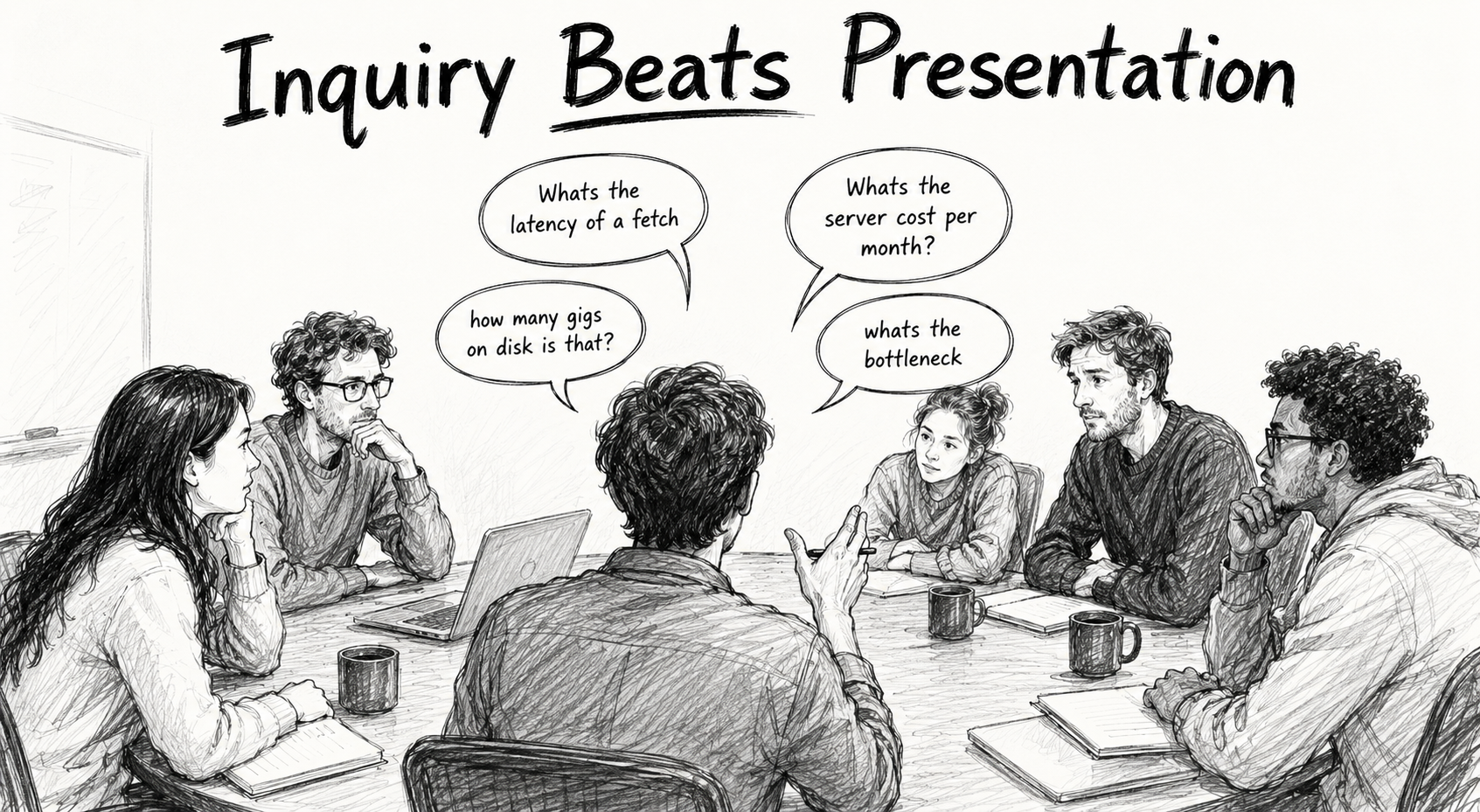
The solution to this is what I call an Inquisition. It’s a meeting in which there is one person who runs the meeting, the Inquirer, and they lead everything through questions. So rather than people giving presentations, everything is a dialogue. The person answering should be prepared to be interrupted and not talk for too long at a time, and the vibe in the room needs to be good enough that this isn’t awkward or intimidating. It’s just a matter of time efficiency. The conversation should be directed toward what the inquirer cares about.
You can run a design review this way where engineers still prepare slides and visual materials. But rather than following the linear flow that the designer thinks makes sense, the inquirer jumps in with questions and we jump around, following a thought process.
The key problem this solves is that it makes the meeting about information extraction rather than someone just broadcasting information. This type of meeting pulls information out of people rather than forcing people to push information onto a crowd. It’s actually pretty hard to push information effectively. It’s much easier for a curious person to extract it. This is one of the reasons we listen to podcasts with a guest and a host, rather than just listening to a lecture from a single speaker.
The inquirer is not the only one who can ask questions; they are simply the one chiefly responsible for guiding the lens of the meeting toward interesting information, efficiently. It takes a bit of skill to be good at inquiring efficiently, but less than you would expect. It’s much easier to sit around and ask questions following your curiosity, as long as you’re actually curious, than it is to figure out how to present well in an engaging and useful way. For myself: I’m a terrible presenter, but a great inquirer.
I use this method in as many places as I can now, including all-hands. Rather than presenting at all-hands myself, I have someone inquire me. For the bulk of the meeting, where I go over updates, I have someone on the team prompting me and asking me questions about the different subjects we want to cover. That way it’s a back-and-forth dialogue, and the person asking questions can make sure I’m answering the details the audience actually cares about. I care about answering questions; they care about the audience. This ends up being so much more information-rich for the average employee than when I just talk at the room for 30 minutes straight.